Sparkling Services provides attic clearance in Brussels, Flanders and Wallonia, from boarded lofts reached through a hatch to the converted roof rooms of a tall town house. We set family archives and keepsakes aside, bring every item down without damaging the stairwell, then split everything between donation, recycling and specialised disposal. The visit is free, so is the written quote, and depending on the value of what is stored under your roof, the clearance is free, we pay you the difference, or you pay a fixed price on quotation.
What our attic clearance covers
An attic clearance by Sparkling Services covers the whole job, from the first box to the final sweep: sorting with you, carrying every item down to the ground floor, loading, then splitting everything between donation, recycling and specialised disposal. You never have to climb the ladder or carry a single crate.
The word ‘attic’ covers very different spaces, and each one is cleared in its own way:
- The unboarded loft: exposed joists, a few loose boards, access through a hatch or a pull-down loft ladder.
- The attic under the roof timbers of an older house, with a proper floor, a steep ship's ladder and sometimes a former maid's room.
- The converted roof room or mansard bedroom: sloping walls, small roof windows, furniture carried up piece by piece.
- Eaves cupboards and the storage behind knee walls, where the oldest boxes often hide.
- The attic of a shop-house or farmhouse, sometimes used as a stockroom for decades.
We clear the whole attic or just part of it: for example freeing the loft before works while leaving in place a wardrobe you want to keep.
Why and when to clear your attic
An attic fills up quietly over twenty, thirty or fifty years. The day it has to be emptied nearly always comes with a deadline: building work, a sale or an estate.
- Before roof insulation or a roof renovation: the roofer or insulation firm needs a completely clear loft to lay insulation, replace the underlay or treat the timbers. It is best to free it a few days before work starts.
- Before converting the loft into a bedroom, office or playroom.
- Before a sale: surveyors and buyers want to see the state of the timbers, roof and insulation, not a mountain of boxes.
- When settling an estate: the parents' or grandparents' attic is often the fullest room in the house, and the hardest emotionally.
- When pigeons, martens or rodents have moved in, or after a roof leak has soaked the boxes.
- Simply to get useful storage back.
If the basement, garage or the whole house also needs clearing, we combine the attic clearance with a basement clearance or a house clearance on a single quote; after a death, our estate clearance service takes care of the entire property.
Narrow stairs, hatch or loft ladder: how everything comes down
Access is the real difficulty in an attic, far more than volume. Everything stored under the roof has to come back through an opening that is often smaller than a cupboard door. So we plan the descent before moving the first item.
- Loft ladder or hatch: one person upstairs, one at the foot of the ladder, a third on the ground floor. Items come down one at a time, in closed boxes of a reasonable weight; nobody climbs down a ladder with a heavy load in their arms.
- Ship's ladder or a very steep top flight: we clear the way first, protect the treads and banister, then pass everything down in a chain.
- Furniture that went up decades ago: a wardrobe, bed or trunk was sometimes assembled on site, or taken up before the current stairs were fitted. We dismantle it and, if needed, cut it down to get it through.
- Roof window: used only if its size and the layout allow it without risk; it is never the default option.
On the floors below, we protect the flooring and the corners of the stairwell, especially when the house is still lived in or has just been renovated.
Fragile floors, low beams and heat: working safely under the roof
A loft is not like any other room. Before starting, the team identifies where you can put your weight and where you cannot.
- Joists and boarding: in an unboarded loft there are often only a few planks laid across the joists, with nothing but a plaster or lath ceiling in between. One misplaced foot is enough to go through. We walk on the joists or on crawl boards, and never stack heavy items in one spot.
- Low beams, collar ties and roofing nails: head protection, portable lighting and slow, deliberate movements.
- Heat: under a poorly insulated roof the temperature climbs fast in summer. In hot weather we start early in the morning, take regular breaks and bring water for the team.
- Dust: decades of dust rise with the first box moved. The team wears suitable masks, and we advise closing the doors of the rooms below.
- Electric cables: old wiring often runs loose across the loft floor; we never drag an item without seeing what lies underneath.
Summer clearances: heat under the roof
Under a poorly insulated or uninsulated roof, an attic soon gets hotter than outside once the sun is on the tiles. Carrying boxes in those conditions takes organisation from the team, and it can affect the date we suggest.
How we work in hot weather
- Early start: in summer we start early and do most of the work under the roof in the morning, before the heat builds up.
- Lighter loads: boxes filled less, more frequent trips, and rotation between those working under the roof and those loading the truck.
- Water and breaks: water on the landing and regular breaks somewhere cool.
- Ventilation: roof windows and dormers opened on arrival whenever possible.
What you can do
- Open the attic and its windows the evening before, so the heat can escape overnight.
- Tell us whether there is a socket upstairs, for a fan or lighting.
- If a heatwave is forecast, we can move the job by a few days or split it over two mornings.
Belongings suffer in the heat too: candles, vinyl records, photos and old film can warp. Anything you want to keep comes down first.
Insulation, asbestos, pigeon droppings: what we leave to specialists
An attic clearance means removing what is stored there, not taking the building apart. That boundary matters, for your safety and ours.
Insulation
We do not remove insulation that is in place, whether glass wool, rock wool or old loose-fill. New rolls or offcuts stored in the attic, on the other hand, can be taken away, wrapped to limit fibres. If the existing insulation has to go for a renovation, that is the job of the roofing or insulation contractor.
Asbestos
In older buildings, some roof underlay sheets, fibre-cement slates, flues or old insulating materials may contain asbestos. We never touch them: we point them out and refer you to a certified firm for removal. The rest of the attic can be cleared around them, provided the suspect materials are intact.
Pigeons, nests and pests
Dried pigeon droppings can carry pathogens and must not be swept up dry. When an attic holds a lot of them, we work with masks and gloves, dampen before collecting and bag that waste separately. Abandoned nests are removed; with an active colony, martens or rodents, a pest-control specialist needs to come first. Have the gap the birds use sealed too, or the problem will return.
Wasps, hornets and nests under the roof
A quiet, warm attic that people rarely visit is an ideal shelter for wasps and hornets. Nests hide under the tiles, against a purlin, inside an open box or behind the insulation. That is why we always start with a look around by torchlight before moving anything.
Our rule: we never touch a nest
We never destroy, move or remove a wasp or hornet nest, even one that looks abandoned. If we spot one, we stop work in that area, point it out and carry on elsewhere if it is safe to do so. Dealing with the nest is a job for a pest control company or, depending on local practice, the fire brigade of your emergency zone: check which arrangements apply where you live. Asian hornet nests are also covered by reporting schemes run in each region.
Good reflexes
- Insects always flying in and out at the same point in the roof? Mention it when you first contact us.
- Do not spray at random and do not block the nest entrance: the insects may look for a way out into the house.
- Have the nest treated a few days before the clearance, so the job can run without interruption.
- Anyone allergic to stings should stay out of the attic while the nest is active.
Family archives, trunks and keepsakes: sort before you clear
An attic is not just a store of junk: it is often the family's memory. Before anything leaves, we set aside whatever might matter to you.
- Boxes of photos, slides, home films and albums.
- Letters, notebooks, announcement cards, school reports and children's drawings.
- Official papers: deeds, property titles, contracts, old bank documents.
- Closed trunks and suitcases, whose contents are checked one by one.
- Medals, military items, jewellery forgotten in a sewing box.
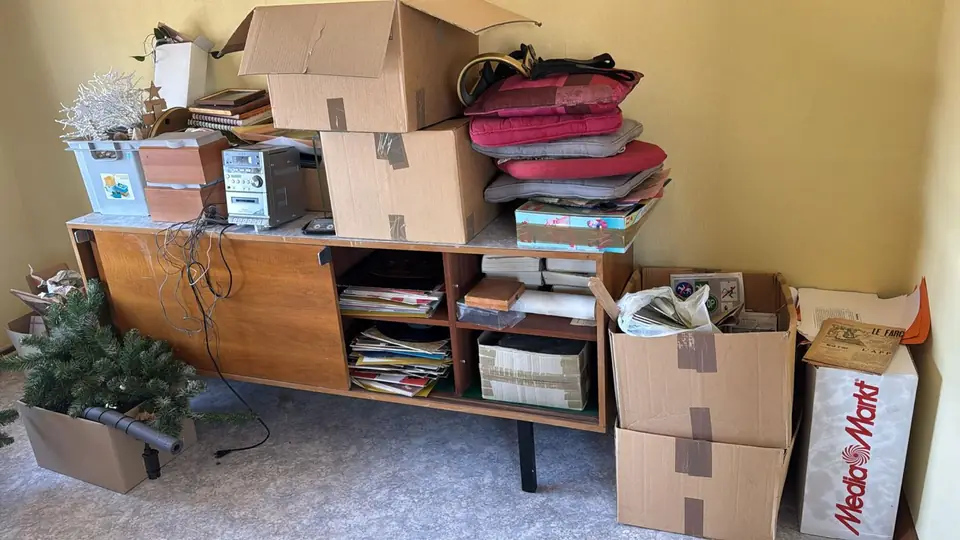
- Old toys, model trains, dolls, comics and vinyl records, which may have collector value.
These items are gathered in labelled crates that you go through whenever suits you. If you cannot be there, we send photos before any decision is made. Personal documents you do not keep never go out with loose paper recycling: we set them apart and you decide how they are destroyed.
What happens to the items from your attic?
Everything that comes down from the attic is sorted on the landing, so each item heads in the right direction.
- Antique furniture, trunks, chests, mirrors: if they have resale value, it is deducted from the price; otherwise they are offered for reuse.
- Christmas decorations, toys, children's bikes, books, crockery: offered to social-economy organisations (for example Les Petits Riens, Oxfam, Terre or De Kringwinkel), depending on what they accept.
- Clothes and textiles: clean and dry, they go to a textile collection; moth-eaten or damp, they are disposed of.
- Old mattresses, bed bases and armchairs: sent to suitable recycling channels.
- Electrical appliances (old televisions, portable heaters, fans): through the take-back network for electrical and electronic waste.
- Wood, metal, paper and cardboard: sorted by material for recycling parks and sorting centres.
- Paint tins, varnish, wood-treatment products, aerosols: kept apart and taken to a hazardous-waste collection, never mixed with the rest.
How much does an attic clearance cost?
We do not publish rates, because an attic full of family furniture and an attic full of damp boxes are not comparable. The price follows one of three formulas:
- Free clearance: the value of reusable or saleable items (antique furniture, trunks, collectables) covers the cost of the job.
- We pay you the difference: when that value exceeds the cost of the clearance, we pay you the balance.
- Fixed price on quotation: when the attic mainly holds items of no value, you pay a fixed price agreed before the job.
What makes an attic quote vary:
- the access (stairs, ship's ladder, loft ladder, hatch) and the number of floors to carry down;
- volume and weight, especially furniture to dismantle under the roof;
- the state of the floor and the room available to move around;
- droppings, damp materials or hazardous waste;
- the sorting time needed for archives and keepsakes.
The visit is free, so is the written quote. A few photos sent via WhatsApp or the form are often enough: photograph the access (hatch, ladder or stairs) as well as the contents.
How long does it take to clear an attic?
The visit usually takes place within 48 hours, then we agree a date together; the job can often be scheduled within 1 to 3 days. An average attic served by a staircase is usually cleared in half a day to a day. A loft packed up to the purlins and reached only through a hatch, or an attic with a lot of paperwork to sort, can take longer.
If your roofer or insulation firm already has a start date, give it to us when you ask for a quote: we schedule the clearance a few days before, so the state of the roof can be checked once the loft is empty.
You do not need to be present throughout. It is often enough to be there at the start to show what you are keeping, or to leave us a list and a key.
Checklist: preparing your attic clearance
- Go up one last time with a torch and mark everything you want to keep with coloured tape.
- Open closed trunks and suitcases, or tell us about them so we can check them with you.
- Photograph the access (hatch, ladder, stairs) and the whole loft for the estimate.
- Mention any sheets or materials that could contain asbestos.
- Report signs of pigeons, martens or damp.
- Clear the landing and the corridor under the hatch, and move fragile items out of the stairwell.
- If a roofer or insulation firm is coming, give us their start date.
- In town, think about parking for the truck: we can help with the parking request.
Send your photos via the form or call +32 485 39 99 41: you will receive a free estimate, usually within 24 hours.